Audience: Beginner, Intermediate, Expert · ~12 minutes
Imagine hiring a brilliant intern who is locked in a soundproof glass room. You can slide questions under the door, and astonishingly good answers come back — essays, code, analysis, poetry. But the intern can’t open your calendar, can’t check your database, can’t email your customer, can’t talk to the intern in the next room. Everything they know was learned before they walked in, and everything they produce, you have to carry out yourself.
That was AI in 2023. The story of the last four years is the story of unlocking that door — one leap at a time. Each leap corresponds to one node on the visual accompanying this post: an idea, a search, a factory, and a rocket. By the end, you’ll understand not just what changed, but why the order in which it changed was inevitable.
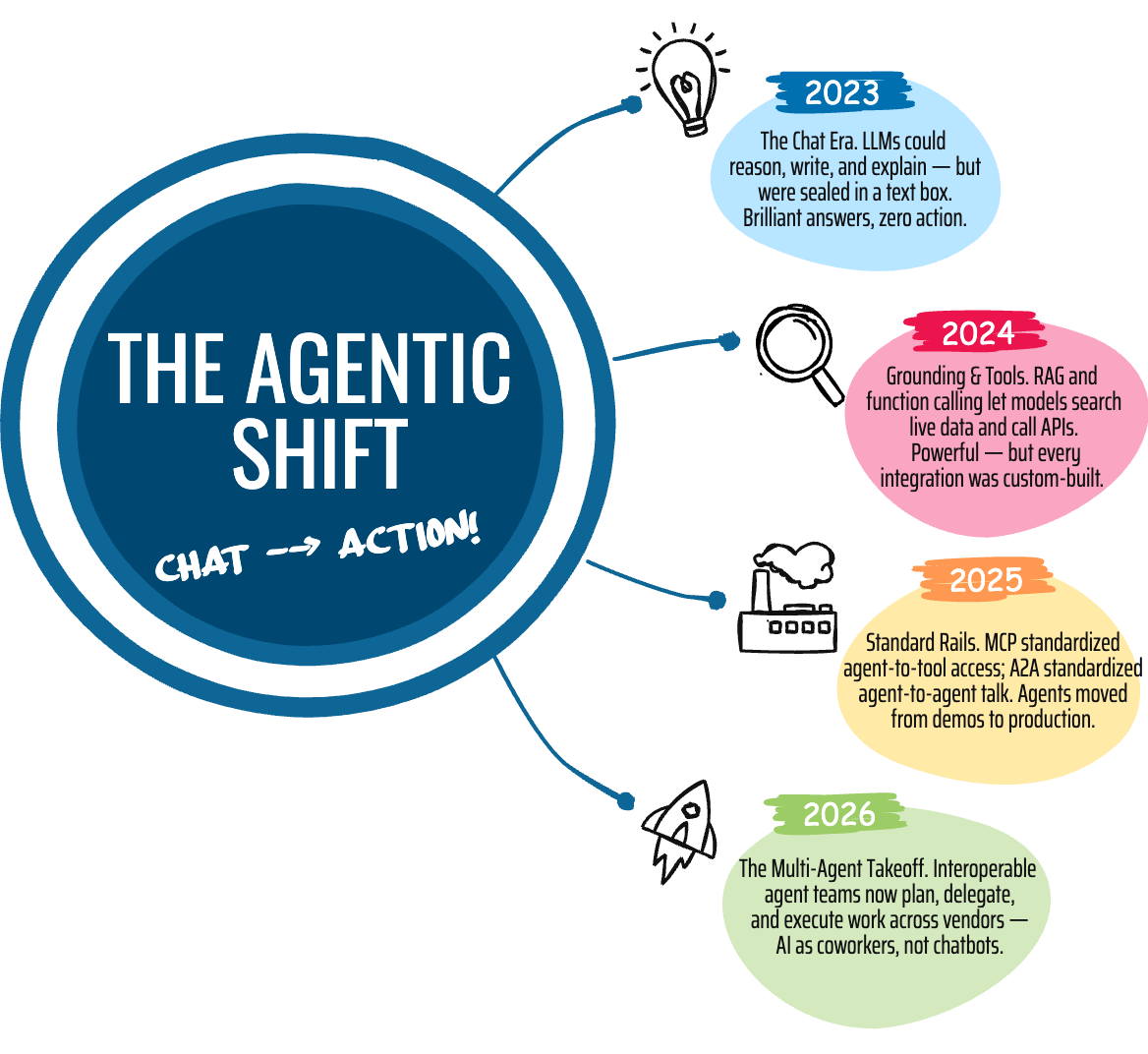
Phase 1: 2023 — The Chat Era (The Brilliant Brain in a Jar)
Beginner Perspective
When large language models exploded into public consciousness, what stunned everyone was the quality of the answers. For the first time, software could hold a genuinely useful conversation about almost anything. But two things were quietly broken. The model’s knowledge was frozen at its training date — it couldn’t tell you today’s stock price or your own order status. And its only output was text: it could describe how to file an expense report, but it could not file one. It was the intern in the glass room — pure intelligence, zero reach.
Intermediate / Expert Deep Dive
Formally, the 2023-era LLM had no perception of the live world and no actuators to affect it. Every deployment was a stateless text-in/text-out call, and every attempt to make it “do” something meant a human copy-pasting the output into a real system. Enterprises discovered the gap between capability and usefulness the hard way: the intelligence was real, but it was bottlenecked by connectivity, not cognition. That diagnosis — the model isn’t the problem, the isolation is — set the agenda for everything that followed.
Technology Spotlight: Foundation LLMs, prompt engineering, context windows.
Key Challenge: Frozen knowledge and no ability to act — brilliant answers that someone still had to carry out by hand.
Phase 2: 2024 — Grounding & Tools (The Model Learns to Look Things Up)
Beginner Perspective
The second leap gave the model eyes and hands. Retrieval-Augmented Generation (RAG) gave it eyes: before answering, the system first searches a trusted source — your documents, your database — and hands the model the relevant passages to base its answer on. Less making things up, more citing evidence. Function calling gave it hands: developers describe an action to the model (“here is a function called book_meeting; it takes a date and an attendee list”), and instead of replying in prose, the model replies with a structured request to perform that action. Suddenly it could check inventory, query a CRM, send a message.
Intermediate / Expert Deep Dive
The loop that emerged here — reason → act through a tool → observe the result → reason again — is the beating heart of every agentic system since; it is precisely what turns a language model into an agent. But 2024 had a dirty secret every builder remembers: every integration was hand-crafted. Connecting a model to Salesforce meant custom code; connecting a different model to the same tools meant rewriting everything. The industry was building N×M bespoke bridges — every model to every tool — via one-off OpenAPI wrappers and custom HTTP endpoints, and every team’s glue was different. It was the web before HTTP, peripherals before USB. Which told everyone exactly what the next leap had to be.
Technology Spotlight: RAG pipelines, vector search, function/tool calling, the ReAct loop.
Key Challenge: Integration sprawl — powerful one-off agents, zero reusability, no standards.
Phase 3: 2025 — Standard Rails (The Year Agents Went to the Factory)
Beginner Perspective
2025 is when the industry stopped building bespoke bridges and started laying shared rails — which is why the factory icon fits: this is the year agents moved from demo to production. Two open standards did the heavy lifting. MCP (Model Context Protocol) standardized how an agent connects to tools and data — think USB-C: instead of a custom cable for every device, one universal port. A company exposes its database or ticketing system as an MCP server once, and any MCP-capable agent, from any vendor, can plug in. A2A (Agent2Agent Protocol) standardized the other conversation: not agent-to-tool, but agent-to-agent — how independent agents discover each other, delegate tasks, and coordinate work.
Intermediate / Expert Deep Dive
The two protocols are complementary layers, not competitors: MCP is how an agent uses its hands; A2A is how agents hold a meeting. MCP, created by Anthropic, was adopted natively by every major provider — Anthropic, OpenAI, Google, Microsoft, Amazon. A2A, announced by Google Cloud in April 2025 with 50+ launch partners, addresses agents as independent systems with their own ownership, tools, and trust boundaries. The institutional moment came in December 2025, when governance of these standards moved to the Linux Foundation’s Agentic AI Foundation (AAIF) — co-founded by OpenAI, Anthropic, Google, Microsoft, AWS, and Block. Fierce competitors jointly stewarding vendor-neutral infrastructure is the single strongest signal that agents crossed from experiment to essential. In parallel, production-grade frameworks — Google’s Agent Development Kit (ADK), LangGraph, and peers — made sessions, memory, evaluation, and deployment first-class engineering concerns rather than research afterthoughts.
Technology Spotlight: MCP, A2A, AAIF governance, agent frameworks (ADK, LangGraph), agent evaluation tooling.
Key Challenge: Convergence — getting an entire industry of rivals onto shared, neutral rails without fragmenting into competing standards.
Phase 4: 2026 — The Multi-Agent Takeoff (From One Agent to a Workforce)
Beginner Perspective
Which brings us to now — the launch. The frontier in 2026 is not one clever agent but teams of specialized agents: a planner that breaks a goal into steps, a research agent that gathers evidence, a domain agent that executes in the business system, a reviewer that checks the output — coordinating with each other while a human keeps judgment, review, and accountability. Enterprises increasingly describe these less as software features and more as digital teammates handling support triage, research, claims intake, and code. The rocket isn’t a bigger brain; it’s an interoperable workforce.
Intermediate / Expert Deep Dive
The adoption numbers confirm this is no longer niche. By early 2026, MCP had crossed 97 million monthly SDK downloads — React-scale adoption reached in sixteen months instead of three years. A2A passed 150 supporting organizations at its one-year mark, embedded directly into major cloud platforms and running in real enterprise production. Meanwhile the industry conversation has visibly shifted from “how big is the model” to “how reliably does it complete real tasks without supervision” — reliability, cost, and governance now outrank raw scale in most enterprise evaluations.
Technology Spotlight: Multi-agent orchestration over A2A, MCP tool ecosystems, agent observability and evaluation platforms, cloud-native agent runtimes.
Key Challenge: Reliability at scale — proving agents complete real work correctly, safely, and at an acceptable cost, thousands of times a day.
For the Experts: What’s Genuinely Still Hard
If you build these systems, you know the takeoff comes with turbulence. Four open problems are worth naming honestly.
Architecture discipline. The strongest practitioner guidance in 2026 is refreshingly conservative: start with one agent plus MCP tools, and add A2A only when agents are genuinely independent systems with their own ownership and trust boundaries. Multi-agent systems are harder to debug, costlier to run, and slower to respond; distribution should be earned, not defaulted to. An MCP server that “coordinates agents” is a design smell — MCP exposes tools; orchestration belongs to A2A or your framework.
Observability. No protocol yet mandates structured logging or OpenTelemetry integration, so every production team builds tracing independently — and debugging a failure across a multi-vendor agent chain remains genuinely painful.
Identity and trust. When an agent calls an agent that calls a tool, whose permissions apply? Know-Your-Agent frameworks, W3C decentralized identifiers, and verifiable credentials are on the convergence roadmap but aren’t yet production infrastructure for most teams. Until they are, security reviews — especially around prompt injection across agent boundaries — must be paranoid by design.
Cross-protocol interoperability. An A2A agent still can’t natively delegate to an agent speaking a different protocol within a unified task lifecycle. The joint MCP/A2A specification work slated for later in 2026 is the first formal step toward protocol-level bridges — watch it closely.
What to Take Away — At Every Level
If you’re a beginner: AI’s big shift is from answering to doing. Chatbots gave advice; agents complete tasks. The unlock wasn’t a smarter brain — it was connecting the brain to the world, safely and in a standard way.
If you’re an intermediate builder: learn the loop (reason → act via tool → observe → repeat), learn MCP, and resist multi-agent complexity until a single well-tooled agent genuinely can’t do the job. Standard protocols are table stakes now — custom integration glue written in 2026 is technical debt on day one.
If you’re an expert: the protocol war largely resolved into layers — MCP won agent-to-tool, A2A is consolidating agent-to-agent, and both live under neutral governance. The differentiator has moved up the stack: shared governed context, evaluation, observability, identity, and cost control. Protocol compliance gets your agents to the starting line; operational rigor keeps them running in the same direction.
Four years ago, we slid questions under the door of a glass room. Today, the door is open, the intern has colleagues, and they’re all on the same network. The agentic shift isn’t coming. You’re standing in it.